The kitchen gadget I’d give drawer space to
Three questions to ask before any gadget gets a place in your kitchen drawer, tested on a folding chopping board.
You know the drawer. It opens four-fifths of the way, stops with a small, accusatory clunk, and refuses to go any further, because one utensil is sitting half an inch too high and has wedged itself under the bench. You jiggle, you lift, you rearrange. Eventually it slides. Tomorrow, you will do it again.
That drawer is a handy test for any gadget, because everything in your kitchen is paying rent in space. Some things earn their keep every day. Others sit there for years, catching on things, waiting for the one night they’re needed. So what earns a gadget its space?
I ask three questions. They work whether you’re eyeing a spiraliser or a new pair of tongs.
1. What recurring annoyance does it solve?
Look for a small irritation that happens again and again, not a one-off ambition. “Handy if I ever host a banquet” doesn’t count. “Every weeknight I do this fiddly thing” does. The more often the annoyance turns up, the more often the gadget gets used, and the easier it is to forgive its footprint.
2. Can I see how it works?
The best kitchen design makes sense in about five seconds. If you need the instruction booklet to grasp the idea, you’ll need it again at six o’clock on a Tuesday. A good gadget’s trick can be shown in a short demonstration, which is why we draw cartoons.
3. Will I use it often enough to store and clean it?
Every gadget has a hidden second job: finding it a home and washing it afterwards. A tool that saves ninety seconds of chopping but costs five minutes of scrubbing is a poor trade. Check what it’s made of, how the maker says to clean it, and how much of your drawer it will take.
Putting the questions to the Chop2Pot
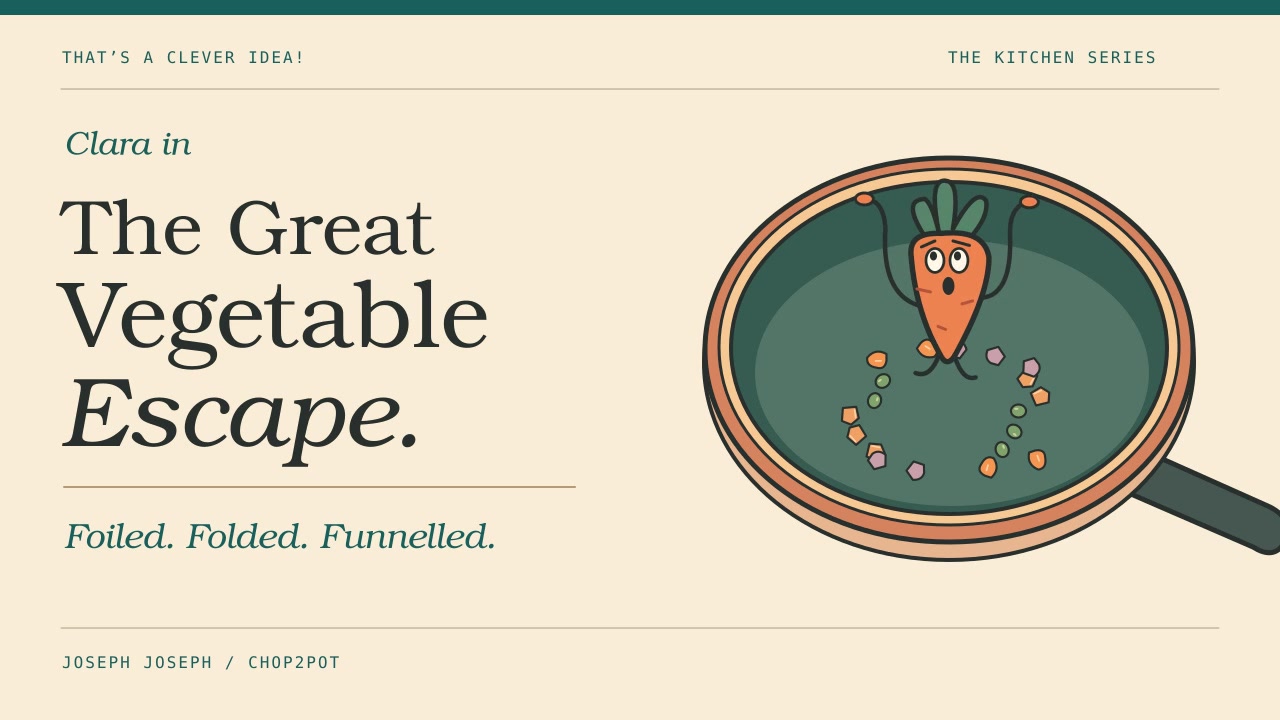
The Joseph Joseph Chop2Pot is a folding chopping board, and it makes a fair example because its idea is easy to state. You chop as usual, lift the board over the saucepan and squeeze the handle. The sides fold up and guide the chopped pieces into the pan. Clara demonstrates, with a carrot who has other plans, in The Great Vegetable Escape.
The annoyance. The trip from board to pot is a real and familiar one, and it comes with its own small hazards: pieces that skate off the edge, and the scrape-and-shuffle that follows. If you chop vegetables for the pan most nights, it recurs. If you mostly eat salad, it doesn’t.
Can I see how it works? Yes. Squeeze, fold, tip. That’s the whole idea, and the animation shows it in a few seconds.
Will I use it enough to store and clean it? I can’t answer this one for you, and I haven’t used the board myself, so I won’t pretend to. Anything that folds has seams, and seams are where I’d look first when thinking about cleaning. I’d also check how much drawer or cupboard space it needs before deciding. The answers should be in the maker’s product details.
Keep the questions, skip the board
If the Chop2Pot isn’t for you, no harm done. The questions travel. The next time something catches in your drawer, ask whether it earned its place. Then, if the answer is no, you’ve just freed up half an inch.